From linear journeys → probabilistic, state-based, conversational systems
There was a time when “user flows” were the backbone of product design.
We drew neat boxes.
We connected arrows.
We defined happy paths, edge cases, and funnels.
It worked—because products were deterministic.
A button led to a screen.
A screen led to a result.
A user moved forward in a predictable sequence.
But AI products don’t behave like that anymore.
And more importantly—they don’t experience like that.
We’re now designing systems where outcomes are not linear, but probabilistic, where interfaces are not static, but stateful, and where interaction is not navigation, but conversation.
In this world, traditional user flows are not just insufficient.
They’re misleading.
1The Illusion of Linearity
User flows assume a simple truth:
If the user follows the path, the outcome is guaranteed.
AI breaks this assumption.
Because now:
- The system may respond differently each time
- The same input may produce multiple valid outputs
- The “next step” depends on context, not sequence
- The interface adapts while the user is interacting with it
A user is no longer “moving through” a flow.
They are co-navigating a system that responds back.
The flow diagram collapses because there is no single path anymore—only possibility spaces.
From Flows to States: The Real Unit of Design
In AI products, the fundamental design unit is not the screen.
It is the state.
A state includes:
- what the system knows
- what the user has done
- what the AI has inferred
- what level of confidence exists
- what actions are possible next
For example, in a fintech AI assistant:
- A “new user state” behaves differently from a “confused user state”
- A “high confidence AI prediction” triggers automation
- A “low confidence scenario” triggers clarification or human support
This means we are no longer designing journeys.
We are designing state transitions under uncertainty.
That’s a fundamentally different discipline.
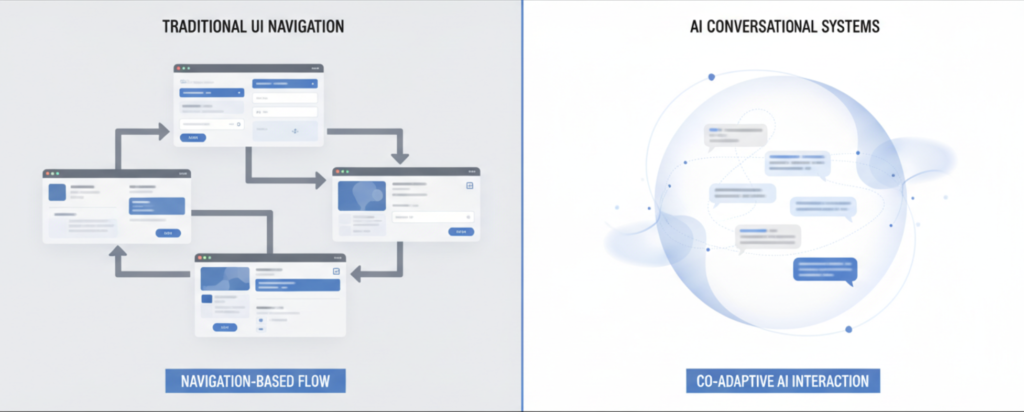
Conversation Replaces Navigation
The biggest shift is not visual—it is behavioral.
In traditional UX:
- Users navigate interfaces
In AI UX:
- Users negotiate outcomes
A chatbot is the obvious example, but this goes deeper than chat.
Even non-chat AI systems behave conversationally:
- autocomplete suggestions
- dynamic form adaptation
- proactive system prompts
- contextual recommendations
Every interaction becomes a turn in a dialogue with the system.
This breaks the concept of “next screen.”
There is no next screen.
Only:
“What does the system do next based on what it now understands?”
Why User Flows Fail in AI Products
User flows fail because they assume:
1. Determinism
AI systems are inherently non-deterministic within bounded ranges.
2. Completeness
Flows assume all paths can be pre-defined. AI introduces emergent behavior.
3. Linear time
AI interactions are recursive—users revisit, refine, correct, and re-query.
4. Static UI
AI interfaces evolve during use, not before it.
So what happens when teams try to force AI into flow diagrams?
You get:
- oversimplified UX maps
- broken edge case handling
- unclear ownership between product, AI, and design
- brittle onboarding experiences
What Replaces User Flows
We need a new design language.
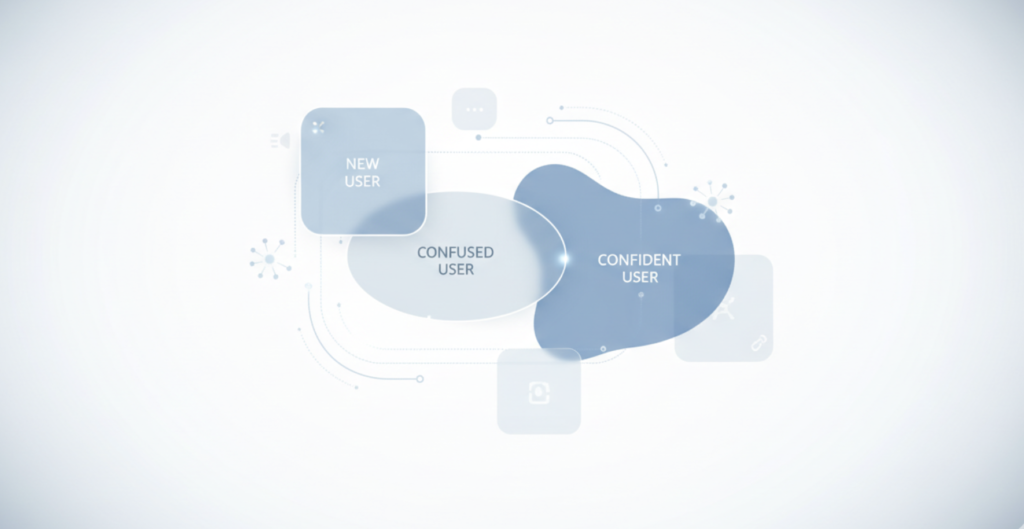
Three primitives replace flows:
1. State Maps (not flows)
Mapping system + user + AI conditions, not sequences.
2. Decision Graphs (not journeys)
Where branching is probabilistic, not fixed.
3. Interaction Loops (not funnels)
Continuous feedback loops between user intent and system response.
This shift turns design from:
“What happens next?”
to:
“What can happen next—and why?”
What This Means for Designers
Designers in AI products are no longer:
- flow builders
- screen designers
- interaction sequencers
They become:
- state architects
- system behavior designers
- uncertainty reducers
The job is no longer to eliminate complexity.
It is to:
make complex systems feel predictable enough to trust.
And that is a very different craft.
Closing Thought
User flows were a language of certainty.
AI products are a reality of uncertainty.
And in uncertainty, design shifts from:
- structure → behavior
- screens → systems
- journeys → states
- flows → conversations
We are not improving user flows anymore.
We are replacing them.